

Insights from the Cannabis Science Conference
Toxicology
Excess Lifetime Cancer Risk (ELCR) is a quantitative toxicological assessment used to estimate the probability that long-term exposure to carcinogenic compounds in a product may increase an individual’s lifetime risk of developing cancer. In the context of Electronic Nicotine Delivery Systems (ENDS), ELCR assessments are primarily based on exposure to harmful and potentially harmful constituents (HPHCs), including carbonyl compounds such as formaldehyde, acetaldehyde, and acrolein, which can form during the heating of e-liquids, and metals, including nickel, cadmium, chromium and lead, which can leach out from the devices on storage and use.
ELCR has become increasingly important in Premarket Tobacco Product Applications (PMTAs) because the U.S. Food and Drug Administration (FDA) now place substantial emphasis on cumulative carcinogenicity and genotoxicity assessments when determining whether marketing a new tobacco product is “appropriate for the protection of public health” (APPH). FDA regulatory science memoranda and PMTA guidance documents indicate that manufacturers are expected to provide robust toxicological evaluations, including cumulative ELCR calculations for relevant aerosol constituents.
Since oral products like nicotine pouches have significantly fewer HPHCs, no ability to thermo-degrade and result in no inhalation exposure, their concern lies mainly with the levels and combinations of each ingredient, and the predicted exposure thereof. Given known carcinogens and mutagens are typically not used as ingredients, a robust ELCR assessment of ‘early and well selected’ ingredients are far simpler and should provide sufficient justification to prove APPH.
ELCR Calculations
At its simplest, the ELCR calculation is the product of the lifetime exposure concentration (EC) and the Inhalation Unit Risk (IUR) of the chemical in question.
ELCR = EC x IUR
The IUR is the risk of a carcinogen per μg/m3 of air. The values are calculated from human epidemiology data or animal carcinogenicity studies by authoritative sources including US EPA IRIS, Cal OEHHA, Health Canada, ATSDR etc, and the toxicologist will compare values and select the most relevant and/or most conservative value. The EC is the expected lifetime exposure (μg/m3) to that carcinogen. For an aerosol, it uses the analytically determined μg/puff (yield), created from an appropriate intense or non-intense puffing regime.
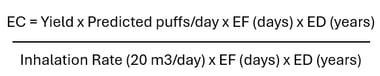
EF = Exposure Frequency is the number of days per year (365)
ED = the number of years expected as an adult (52)
The resultant ELCR value is presented as an exponential notation, e.g. 6.80E-05, which represents 6.8 excess cancer cases in 100,000 people.
Once the ELCR has been calculated for each ‘carcinogen’, any values above unity (1) which represents > 1 additional cancer case per 100,000 people, these are summed together to create the total or cumulative ELCR for the product.
Total ELCR (ELCRc) = ΣELCR
Typically, for e-cigarettes, this would be conducted for HPHCs, leachables and non-targeted analytes to assess the complete cancer risk to the user.
What Value of ELCR is Acceptable?
Data supports the fact that combustible cigarettes will cause cancer in approximately 10-20% of regular ‘lifetime’ smokers. From an ELCR perspective and using the same 100,000 population, this relates to approximately 10,000 to 20,000 additional cancer cases, so the ELCRc for combustible cigarettes would be 10,000 to 20,000.
E-cigarettes are not risk free and any assessment as to their safety is made with reference to combustible cigarettes. According to the FDA in their 2024 memo, Calculating Excess Lifetime Cancer Risks in ENDS PMTAs, the mean marketplace ELCR value for products receiving marketing granted orders (MGOs) was 118, representing 118 additional cancer cases per 100,000 population. While this figure is still significant it represents perhaps only 1% of the risk from combustible cigarettes.
Notwithstanding the equally important other aspects of the PMTA, including clinical data and product performance, the million-dollar question is therefore what ELCR value would be deemed acceptable by the
FDA?
While we know the mean marketplace ELCR value was 118, and we believe this figure may have increased over time, we do not know what the current ‘granted order’ range is and we do not know all of the ‘unknowns’ or ‘assumptions’ within a given submission. Most importantly, we do not know whether regulatory opinion has shifted. What is probably true is that a cumulative ELCR in the range 0-100 for an e-cigarette with no unknowns or assumptions, will unlikely be the reason why that product is not approved.
What are the Unknowns and Assumptions?
An e-cigarette typically uses heat to create a vapour, and this results in thermal degradation, resulting in degradants being produced. Any Extractables and Leachables (E&L) study which identifies Non-Targeted Analytes (NTAs) will typically result in unidentifiable chemicals at levels that are quantified using unvalidated methods.
Even if all NTAs are identified, there will be a % match for each peak against library data which could be 60-
80%, so there is a degree of uncertainty. In addition, quantification is still an issue where non-targeted analytical methods were used, and it is also unlikely there is a full toxicological profile available, so gaps may have to be filled using predictive in silico tools.
Other assumptions may also include that the product is used as intended, is stored appropriately, that each user will consume as expected, and that the devices behave consistently, throughout the product's life cycle.
Historically, in vitro studies were used to assess e-liquids for genotoxicity, allowing any liquids containing unknowns to be tested, however, another 2024 FDA memo on Genotoxicity Hazard Identification in ENDS Premarket Tobacco Product Applications, casts doubt on their suitability and acceptance. Therefore, conservatively, any unidentified peaks may have to be assumed to be genotoxic, and without an IUR, these would have to be assessed at 1.5 μg/day, the threshold level for genotoxic carcinogens. In addition, anyone not measuring NTAs in an aerosol study, may be requested by the FDA to run such a study, one that would struggle to fit into a 90-day deficiency window.
What is clear is that only a toxicologist familiar with PMTA submissions and associated deficiencies of ENDs devices can utilise appropriate resources, provide well-reasoned arguments and use sound judgement to navigate these regulatory hurdles.
Summary
A well-conducted ELCR assessment helps demonstrate that an ENDS product and nicotine pouches present lower carcinogenic risk relative to combustible cigarettes and, increasingly, relative to FDA-authorised comparator products. As a result, a robust ELCR analysis is now considered a critical component of PMTA toxicology packages and can significantly strengthen the scientific justification for product authorisation.