

As global economic dynamics shift, the reduced-risk nicotine industry, already contending with complex regulatory environments, is increasingly feeling the ripple effects of geopolitical tensions....
Toxicology

Jack of All Trades, Master of One
The famous phrase ‘jack of all trades but master of none’ was used in 1741 by Charles Lucas in Pharmacomastix to mock a druggist who tried to act as a doctor, surgeon and chemist, all at once. The implication was that a person who dabbles in more than a single skill may not have the specific in-depth skills required to be an expert.
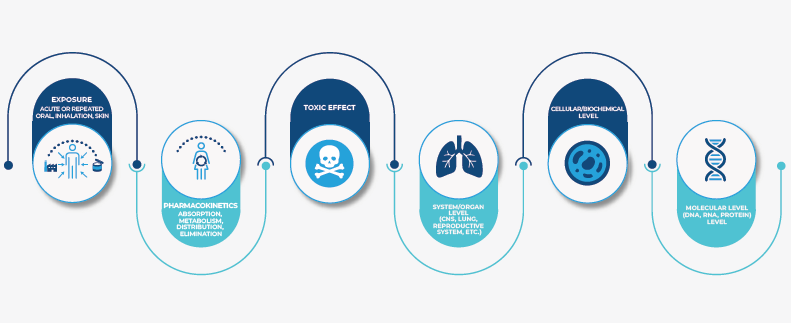
Many different industries require a toxicologist to assess the risk and adverse effects of chemical substances
on living organisms. This could be the tobacco, pharmaceutical, cosmetic or food industry, or perhaps related to medical devices or occupational safety. The diagram below shows the key components of toxicology:
Are All Branches of Toxicology the Same?
Different branches of toxicology often appear highly specialised, but they share a common underlying logic:
they all ask whether exposure to a substance could plausibly cause harm, under what conditions that harm might occur, and whether the expected level of exposure is low enough to be considered acceptable. Whether the toxicologist is assessing a food flavouring, a pharmaceutical impurity, an occupational chemical, an environmental contaminant, a cosmetic ingredient, or an e-cigarette aerosol constituent, the same core principles usually apply: hazard identification, dose– response assessment, exposure assessment, and risk characterisation.
The differences between these areas are often less about the fundamental science and more about the route of exposure, the exposed population, the regulatory framework, and the acceptable margin of safety. For example, inhalation toxicology may focus heavily on respiratory irritation, particle size, deposition in the lung, and local tissue effects, while food toxicology may focus more on oral absorption, metabolism, systemic toxicity, and daily dietary intake. Occupational toxicology may consider repeated exposure in workers over a working lifetime, whereas consumer product toxicology may consider intermittent use by the general public, including potentially sensitive individuals. Despite those differences, the toxicologist is still applying the same broad method: understand the substance, understand the exposure, compare that exposure with toxicological points of departure, and decide whether the resulting margin of exposure is adequate.
The Multi-headed Charging Adapter
A useful analogy is to think of the toxicologist as a multi-headed charging adapter. Each plug head is shaped differently so it can connect to a different system: for food safety, one for pharmaceuticals, one for workplace chemicals, one for environmental exposure, one for cosmetics, one for nicotine products, and so on. The heads may look different and the rules for each country or sector may vary, but the adapter’s job is fundamentally the same: to safely translate a source of power into a form that the system can accept without overload. In the same way, the toxicologist adapts the risk assessment approach to the specific regulatory and scientific context, while still relying on the same underlying toxicological principles.
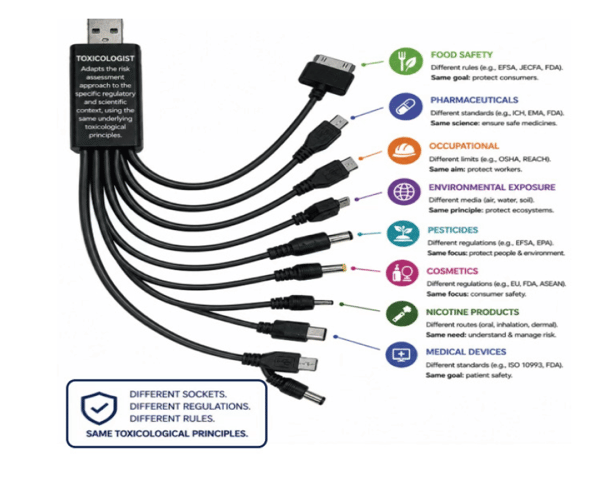
This is why toxicology is both specialised and transferable. A toxicologist may need different technical knowledge for an e-cigarette ingredient compared with a food additive or cleaning-product chemical, but the structure of the evaluation remains recognisably similar. The “plug head” changes depending on the product category, exposure route, and regulatory expectation, but the central device remains the same: a disciplined, evidence-based assessment of hazard, exposure, uncertainty, and safety.
Can a Toxicologist Work in Any Industry?
While the skillsets are the same, the industry-specific knowledge is different and has to be gained. So, while a toxicologist has all of the tools in his box, knowing how and when to use them depends on a number of factors:
• The regulators are different and we gain insight into their expectations even if the written regulations and
guidelines appear concise.
• The regulations and guidelines will be different, and an efficient toxicologist will know these without further investigation.
• The nature of the product, the exposure time and route of exposure will differ, so the toxicology concerns for the patient/user are different and require alternate risk assessments and mitigations.
• The chemicals will be different, so quick-fire knowledge will be less, requiring more searching and hazard assessment.
However, learnings from other industries also allow the toxicologist to think outside the box, to utilise the best practises across industry, seek opinion from experts in their network, so isolation within an industry also has its drawbacks. It is also clear that certain toxicology expertise is used more in some industries than others. The genotoxicity expertise required within the pharmaceutical industry is extensive and few scenarios will not have been encountered. However, with other industries, these scenarios may not have occurred and the solutions or action plans not required.
The Toxicology Consultancy
A toxicology consultancy has typically recruited or developed specialists in a number of different fields so that, dependent on the industry, there is a seasoned expert at hand. In this way, the regulators are known, the regulations and guidance have been learnt, the nuances and intricacies of product types and their ingredients are understood, and the route and duration specific knowledge is deep-rooted. Broughton is just such a consultancy with adaptable toxicologists with a broad-church of experience from pharmaceutical, nicotine, cosmetic and pesticidal backgrounds, working collectively to bring best practice to meet our customer needs.