
Cannabinoids
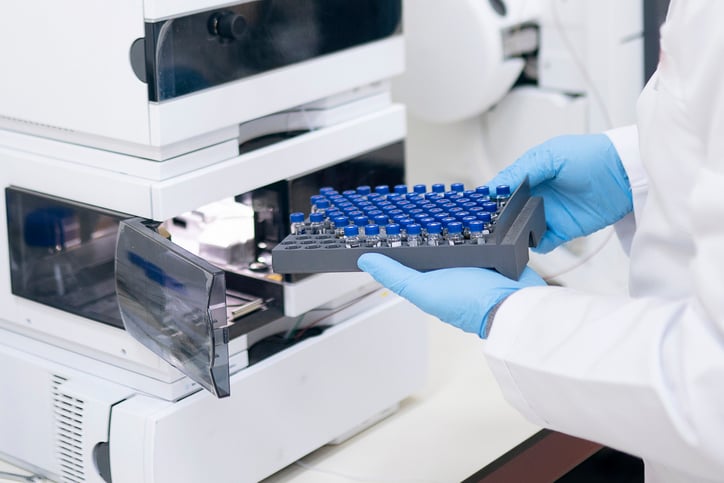
The analytical method used to characterise a cannabinoid product shapes the regulatory evidence available and how far that evidence will carry a manufacturer with an inspector. Both LC-UV and LC-MS are fit for purpose; the question is which purpose. Here, Adam Neaves, our Technical Lead of contract research organisation Broughton, explains the practical differences between the two methods and what to consider when selecting between them.
Most cannabinoid analysis begins using liquid chromatography with an ultra-violet light detector (LC-UV), and for good reason. Cannabinoids and acidic cannabinoids absorb UV light between 210 nm and 300 nm, which means they register clearly on a UV detector following chromatographic separation. The technique is well established across both UK and US regulatory frameworks, set by the MHRA and FDA respectively, and well suited to the high-throughput routine testing that QC batch release demands.
Chromatographic separation can be achieved for a good number of the key cannabinoids being requested at present:
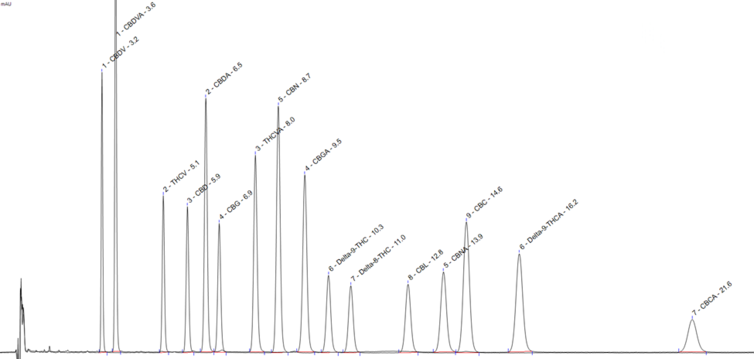 Figure 1: Cannabinoids and cannabinoid acids analysed by reverse phase LC-UV at 228 nm
For a manufacturer running potency verification for one of these cannabinoids in a well-characterised product in a relatively clean matrix, this approach does the job reliably. In addition, this technique can provide some degree of cannabinoid profiling for growers and manufacturers to begin to target their products for specific therapeutic aims.
Where the LC-UV approach can run into difficulty is in situations where the analysis is complicated by large numbers of similar potential analytes (like cannabinoids), matrix interferences or where the analytes are present at very low levels.
UV detection identifies compounds by their absorbance signal, which means any chemical with an absorbance at the wavelength being used can interfere with the analytes of interest. Chromatographic separation can move interferences away from the analytes of interest, but this is not always possible, especially in complex matrices with many ingredients. As UV detection is non targeted, it may also not be obvious that a co-elution is present.
Cannabinoids can be present at very low concentrations in in some matrices, for example aerosols from vaporised material, or as low-level impurities in products. Determining these very low levels accurately may not be achievable by LC-UV.
When mass spectrometry changes what's possible
In a mass spectrometric detector, compounds are identified using molecular masses which can be much more specific to analytes of interest and cannabinoids that co-elute chromatographically, with each other or with matrix interferences, can be distinguished by the detector.
MS detectors are also much more sensitive than UV detectors, and trace-level compounds that a UV detector might miss — because they are present at low concentration or obscured by neighbouring peaks — become quantifiable. The practical difference in sensitivity is substantial. LC-MS methods can achieve limits of quantitation several orders of magnitude lower than UV detection. The dynamic range of an MS detector is also often larger than that of a UV detector, thus a single dilution and injection can cover major and minor cannabinoids across a wide quantitative range simultaneously.
Complex matrices shift the balance further. Topicals and inhaled formulations can introduce significant matrix interference that compromises UV-based quantitation. LC‑MS is substantially more robust in these conditions, allowing for analyte quantitation even in complex matrices.
The trade-off is operational. LC-MS instrumentation costs more, requires skilled analysts to operate and maintain, can require significant method development and validation activities and often requires significantly more time to interpret data. The inclusion of internal standards, especially if isotopic labelling is required, also adds to costs and complexity to method development and validation. Cannabinoid profiling can be achieved using LC-MS, but this introduces additional complexity to the analysis, requiring either a full scan and/or complete understanding of all cannabinoids and their mass spectral fragmentation.
Matching method to objective
There are commonly two mistakes made in selecting analytical tools to meet an objective:
- Applying the logic of routine release testing to a situation that demands something more.
A manufacturer who has run QC release testing successfully by LC-UV may assume the same approach will support a full regulatory submission. It may not.
- Assuming that more sensitive, complex and expensive instruments are better in all circumstances.
When the requirement is for simple matrices with little requirement for analysis of trace levels, LC-MS is often just too much.
LC-UV is the right tool when the objective is potency verification of a defined product, and the major cannabinoids are well characterised. It can be used to provide a good level of cannabinoid profiling and can be used to determine impurity levels but does rely on the matrix not being overly complex. In these circumstances it is fast and cost-effective.
LC-MS becomes necessary when the objective is comprehensive characterisation or determination of low levels, especially in complex matrices where LC-UV suffers from interferences. These situations may arise in early product development stages, in regulatory submissions demanding quantitation of a wide cannabinoid profile or in stability studies where the data must capture what is forming in the product over time.
For a regulatory submission requiring a complete cannabinoid profile, or for a stability study where degradation products need to be detected and tracked as they form, this decision matters considerably. Method selection is rarely wrong because a laboratory lacks access to the right technology. It is most often wrong because the question being asked of the data is not examined carefully enough before testing begins. A cannabinoid profile generated by LC-UV may be entirely adequate; it may also be the reason a regulatory submission requires additional work that could have been avoided.
Having the analytical strategy conversation before analysis starts, with a clear understanding of the analytical objectives, matrix complexity and expected analyte levels, adds the most value.